

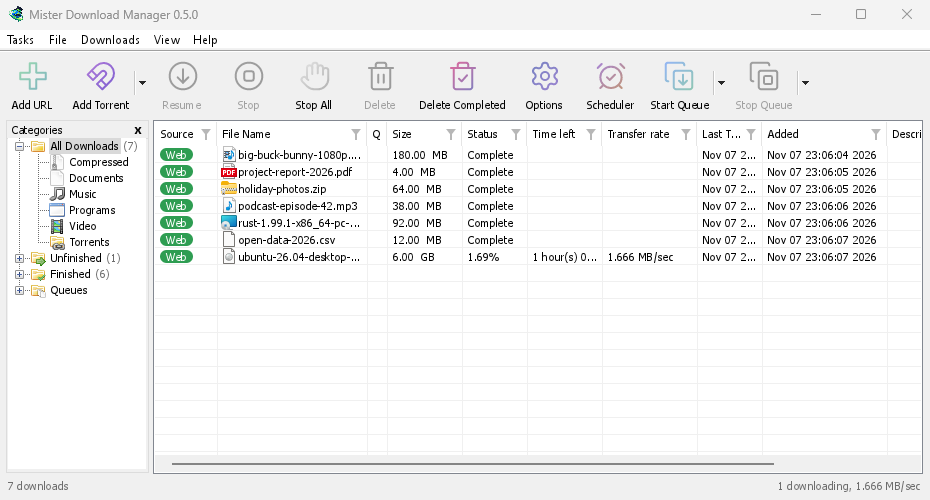
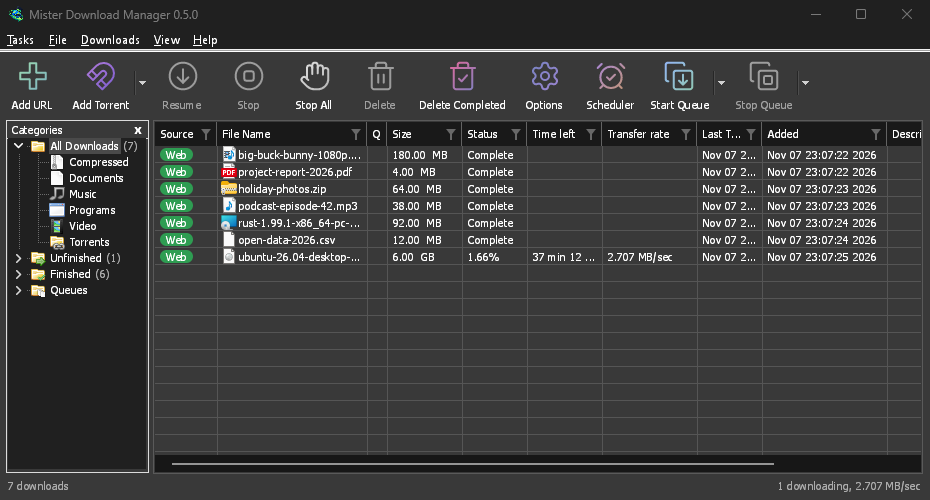
Windows: drie manieren om het te installeren
On 64-bit Windows 10 and 11, GDM is the stable, recommended build. The download page offers three files:
- The installer (
setup.exe), the one to pick unless you have a reason not to. It installs for you alone without administrator rights, or for everyone, and can set up browser integration and open.torrentfiles and magnet links with GDM. - De draagbare versie (
portable.zip), die vanuit elke map werkt. - Het gewone zipbestand (
x64.zip), dezelfde programma's zonder installatieprogramma.
Help → Controleren op updates → Nu bijwerken downloadt een nieuwe versie, controleert de handtekening, plaatst deze en start opnieuw, voor zowel de installatie als de twee zipbestanden.
Draagbaar: alles in één map
Unzip the portable copy anywhere, a USB stick included. The download list, the settings, the
video helpers and torrent data stay in a data folder next to the program, and nothing is
written to the registry. Two things need the installer instead: starting with Windows, and
taking downloads from the browser, since both go through the registry. Carry GDM on a USB
stick shows the set-up.
Mac en Linux: wat u nu krijgt
De bestanden die vandaag zijn gemarkeerd met -experimental zijn voor macOS 11 en nieuwer, op Apple Silicon of Intel, en voor Linux op x86-64: een AppImage voor de meeste distributies, een .deb voor Ubuntu, Debian, Mint en Pop!_OS, een .rpm voor Fedora, openSUSE en RHEL, en een .tar.gz van de kale programma's. Laat het ons weten hoe het ging, goed of slecht.
There, GDM connects itself to your browsers at each start, has its tray icon, follows the
system's light or dark look and uses the system's fonts and ffmpeg. The Mac app isn't notarized
by Apple yet, so macOS asks before its first start: right-click it and choose Open (on
macOS 15 and later, System Settings → Privacy & Security → Open Anyway). A .deb or .rpm
update opens in the system's installer. A few parts work only on Windows, and the help says so
where it matters.
Linux, gecontroleerd op vier desktops
Linux won't be experimental any more: every change is now checked on a Linux desktop as well as
on Windows. GNOME, KDE Plasma, Xfce and Cinnamon were checked window by window: the tray icon and
its menu, Minimize to the notification area, Dark Mode support following the desktop, and the
browsers handing downloads over (Ubuntu's Snap Firefox, Google Chrome and Brave). A Wayland
session runs GDM through XWayland, so menus open under their titles, on tiling compositors such
as sway too. The .deb and .rpm were installed in clean Ubuntu 24.04, Debian 12 and Fedora 45
systems and bring everything GDM needs; from the AppImage or the .tar.gz, a missing library is
named at start with the command that installs it. Update now asks the package manager which
package GDM is.
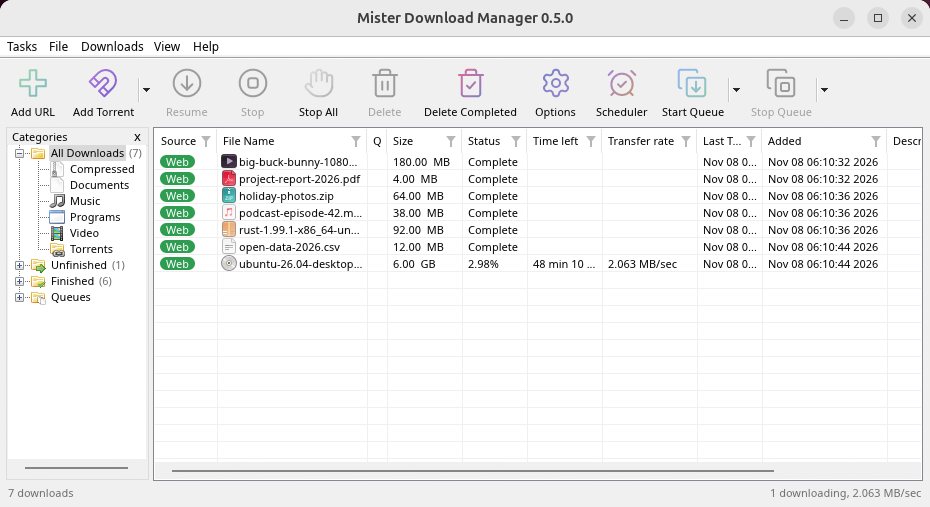
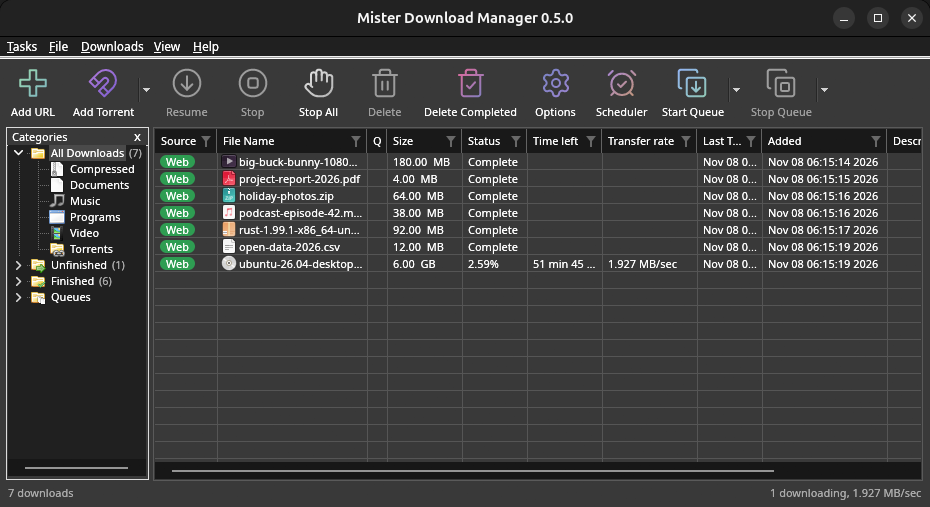
What's left: the Flatpak Firefox isn't checked yet; screen readers (Orca) don't read GDM's windows on Linux yet; and native Wayland windows can't place menus, so XWayland stays the default. macOS stays experimental: its builds are made and tested by GitHub Actions, not yet on a Mac of ours.
Kleinere Mac-downloads, lichtere Linux-updates
The Mac gets two smaller downloads, one for Apple Silicon and one for Intel, instead of one
universal .dmg of 80 MB. From 0.2.4 or older, update the Mac once by hand: Download in
Check for updates opens the release, where you pick your Mac's file. The AppImage can update
through AppImageLauncher, Gear Lever and AppImageUpdate, which fetch only the parts that changed.
Linux can draw with Vulkan and macOS with Metal, from View → Draw with, while OpenGL stays the
default there. In a Wayland session, GDM runs through XWayland so its menus open where you click.
Gratis, open source, geen advertenties, geen proefversie.
Download GolinksPRO Download Manager